
Dermal Fillers
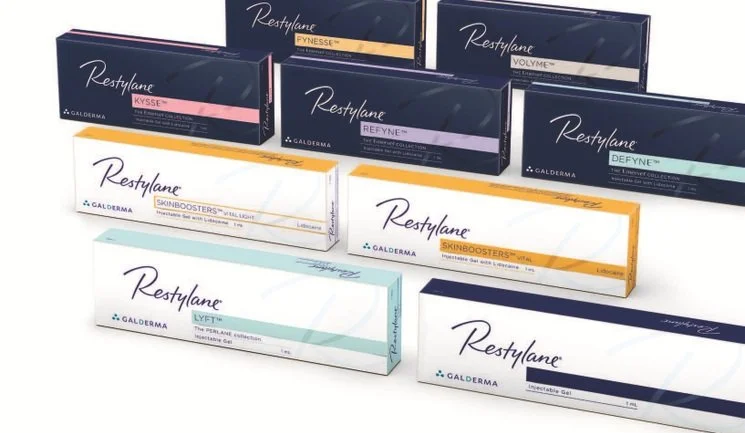
Allergan Product Line
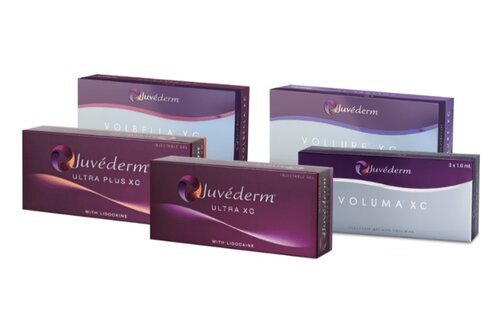
Galderma Product Line
What are they?
Dermal filler treatments can be used to help the appearance of volume loss, soften facial wrinkles and creases, plump & contour lips, and decrease shadows under the eyes. An aging face will naturally lose subcutaneous fat, and filler is a great and easy way to restore a more youthful appearance. Injectable fillers are the second most popular minimally invasive treatment behind neuromodulators (Botox®/Dysport®). At Steadman Aesthetics we only offer the best, industry leading dermal fillers; Juvéderm® by Allergan, and Restylane® by Galderma. Both of these product lines are hyaluronic acid based fillers, which is also a naturally occurring substance in the body. Both Restylane® & Juvéderm® are FDA approved (2003 and 2006 respectively). Fillers are minimally invasive and have progressively evolved over the years and have been through rigorous clinical testing.
What is Hyaluronic Acid?
Hyaluronic acid is a complex sugar that is a naturally occurring component of the extracellular matrix in the body that plays a role in protecting skin from free radical damage. Hyaluronic acid also maintains moisture in the face which helps skin maintain volume and a more youthful appearance.
What kind of results can I expect?
Facial Contour
Results are instant and can last 1 to 2 years
Over time the hydration is absorbed into the body
Results may vary depending on your injector
Softer wrinkles
Plumping
Volumizing
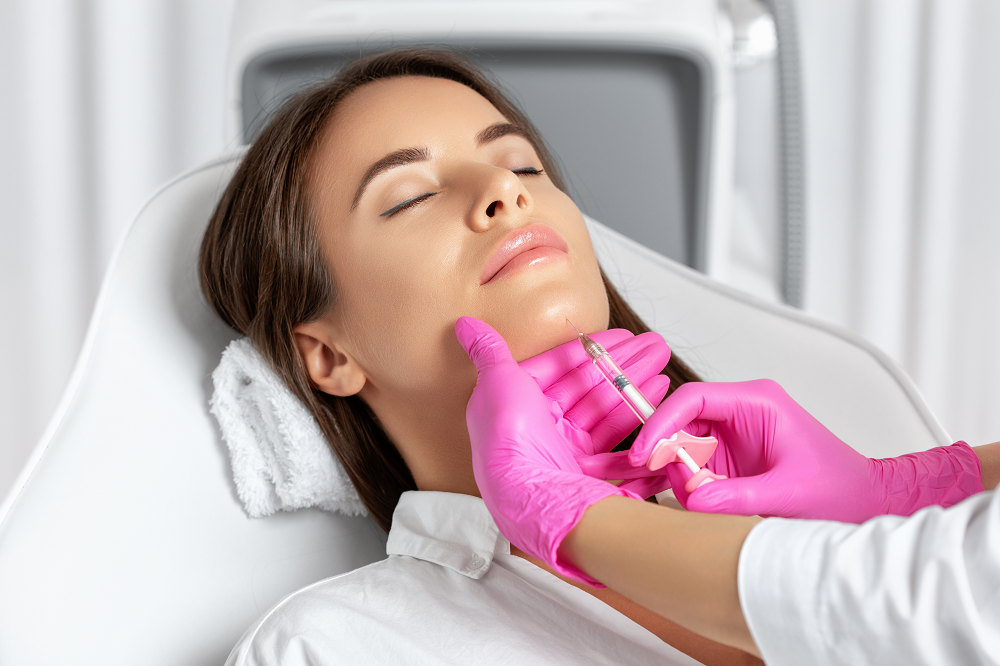
Lips
Nasal labial folds (Smile Lines)
Marionette lines (Frown Lines)
Perioral (Pucker Lines)
Common Injection Areas
Cheeks
Chin
Jawline
Hands
How do I find the right injector?
Getting the rights results starts with finding an injector you can trust, so they can guide you in the right products and create a results plan tailored to you. Your injector needs to know anatomy, facial proportions, placement & depth. They should have a good combination of clinical background and artistic eye. They should also be continually learning and educating themselves on the products, techniques and trends in the industry. At Steadman Aesthetics, our expert injectors are passionate about the industry and have both clinical experience, depth of knowledge, and the artistic eye needed to help you achieve your freshest look.
Pricing & Treatment Areas
Filler Rehab
Are you unhappy with filler you already have from another injector? We can help dissolve and fix it. Pricing below is for dissolving only.
Starting at $400
On Special $250
Gaderma Restylane®
Kysse® Mini Plump
For patients that want a more subtle look the Mini Plump is a great option.
On Special $400
$500
Treatment areas: Nasolabial Folds
Restylane® - 1 mL
$750/Syringe
On Special $650
Restylane® Lyft - 1 mL
Treatment areas: Nasolabial Folds/Midface/Hands
$750/Syringe
On Special $650
Restylane® Silk - 1 mL
Treatment areas: Lips
$750/Syringe
On Special $650
Restylane® Kysse - 1 mL
Treatment areas: Lips
$750/Syringe
On Special $650
Restylane® Refyne - 1 mL
Treatment areas: Nasolabial Folds/Marionette Lines
$750/Syringe
On Special $650
Restylane® Defyne - 1 mL
Treatment areas: Nasolabial Folds/Marionette Lines/Chin
$750/Syringe
On Special $650
Restylane® Contour - 1 mL
Treatment areas: Midface
$800/Syringe
On Special $700
Allergan Juvéderm® Products
Ultra XC - 1ML
Treatment areas: Nasolabial Folds/Marionette Lines/Lips
$800/Syringe
On Special $700
Ultra Plus XC - 1 mL
Treatment areas: Nasolabial Folds/Marionette Lines/Lips
$800/Syringe
On Special $700
Vobella - 1 mL
Treatment areas: Nasolabial Folds/Lips
$900/Syringe
On Special $800
Vollure - 1 mL
Treatment areas: Nasolabial Folds
$900/Syringe
On Special $800
Voluma - 1 mL
Treatment areas: Midface
$900/Syringe
On Special $800
Volux - 1 mL NEW
$1,000/Syringe
Treatment areas: Jawline
On Special $875
Frequently Asked Questions
-
Dermal fillers are injectable gels used to restore volume loss, soften facial lines/creases, contour features (cheeks, chin, jawline), and enhance lips. Most “classic” fillers are hyaluronic acid (HA) fillers—HA is a substance your body naturally has that helps skin hold hydration and look more plump.
-
They’re both FDA-approved hyaluronic acid filler families, but they have different “textures” (how soft/firm they feel) and different strengths designed for specific goals—like subtle lip hydration vs. structured cheek or jawline contour. The best option depends on your anatomy, movement, and how bold vs. natural you want the result.
-
Lips: softer, flexible fillers designed to move naturally when you talk/smile
Cheeks/midface: more supportive fillers for lift and contour
Jawline/chin: higher-structure fillers for definition
Smile lines/marionette lines: balanced fillers that soften folds without looking heavy
Your injector should match filler choice to (1) your facial proportions, (2) your tissue thickness, and (3) the amount of movement in the area.
-
Common filler areas include:
Lips
Cheeks / midface
Chin
Jawline
Nasolabial folds (smile lines)
Marionette lines (lines from mouth corners downward)
Perioral lines (“pucker lines”)
Some patients also use filler to reduce shadowing under the eyes (this area requires advanced technique and conservative dosing).
-
It depends on your starting point and the goal:
Lips: often 0.5–1 syringe for a natural look; more may be staged over time
Cheeks: commonly 1–2 syringes total, sometimes more for significant volume loss
Jawline/chin: often 1–3 syringes total depending on definition goals
Most natural-looking results come from a conservative first visit + a reassessment once swelling settles.
-
Most HA filler results are immediate—you’ll see volume/shape right away, plus some initial swelling. A well-done result should look like you, just more refreshed: softer folds, better facial balance, improved contour, and lips that fit your features.
-
You’ll see a difference immediately, but swelling can temporarily exaggerate the look. Many people look “socially presentable” in a few days. Final settling is often around 1–2 weeks (and sometimes longer in delicate areas like under-eyes).
-
Longevity varies by product, area, and your metabolism. In general, HA filler results often last many months to 1+ year, and facial contour results are commonly quoted around 1–2 years depending on the area and product. Faster-moving areas (like lips) often wear down sooner than structural areas (like cheeks).
-
It doesn’t have to. The “overfilled” look is usually caused by too much product, too frequent topping-off, or putting volume in the wrong layer/area. A safer approach is:
Start conservatively
Build gradually over 1–2 sessions if needed
Focus on facial balance (structure + support), not just “filling lines”
-
Most patients describe filler as quick pressure or pinches. Many HA fillers include lidocaine, and topical numbing and comfort techniques can also be used. Lips tend to be more sensitive than cheeks/chin/jawline.
-
Typical downtime is mild and may include swelling, tenderness, or bruising for a few days. If you’re planning around an event, a smart rule is to schedule filler 2–4 weeks before (especially for lips or under-eyes).
-
Avoid strenuous exercise (can worsen swelling/bruising)
Avoid alcohol (can worsen bruising)
Avoid saunas/hot yoga/high heat
Avoid heavy pressure or aggressive massage to the area
You’ll also want to follow any specific instructions for your treatment area.
-
Common side effects are swelling, bruising, tenderness, and temporary lumps—most settle as the filler integrates. More serious complications are rare, but it’s important to know they exist. The most urgent risk is vascular occlusion (filler affecting blood flow), which requires immediate treatment.
-
Contact your injector immediately (and seek emergency care if instructed) if you have:
Severe or worsening pain (especially out of proportion)
Skin turning white/blotchy, dusky purple, or feeling cool in a specific area
Significant, rapidly increasing swelling
Any vision changes (this is an emergency)
Knowing these signs—and having a clinic that’s prepared to respond—matters.
-
Vascular occlusion happens when filler compromises blood flow (for example, if product enters or compresses a vessel). It’s rare, but time-sensitive. Management can include rapid assessment and, for HA fillers, hyaluronidase (a dissolving enzyme) as part of a medical protocol. This is one reason HA fillers are often preferred: they’re reversible.
-
Both can be safe in trained hands, and many expert injectors use a combination depending on the area. In general, blunt-tip cannulas may reduce bruising and can lower the risk of certain vascular events in some treatment zones, while needles can offer precision in others. The “best” tool depends on anatomy, the plan, and injector skill.
-
Migration means filler shifts outside the intended area (most commonly discussed with lips). Risk can increase with overfilling, injecting too superficially, too-frequent touch-ups, or heavy pressure/massage soon after treatment. Prevention strategies include conservative dosing, correct layer placement, appropriate filler selection, and spacing treatments responsibly.
-
Most HA fillers can be dissolved with hyaluronidase. Some people see changes quickly, but it can take days (and occasionally more than one session) to fully correct. If you’re worried about a past result, “filler reversal” or “filler rehab” is a common, legitimate path—then you can rebuild with a cleaner baseline if desired.
-
“Filler rehab” usually means dissolving unwanted/overfilled HA filler (often from previous work), letting tissues settle, then creating a more natural plan—sometimes with less product, different placement, or staged sessions.
-
In the Denver metro area, HA fillers commonly fall in the mid-hundreds to around ~1,000+ per syringe, depending on the brand, injector experience, and the treatment area. A “typical” visit may be 1–2 syringes total, but some goals require staged sessions over time for the most natural result.
-
The filler brand/product used (some are premium for structure/longevity)
Injector experience and training level
Complexity and risk of the area (under-eyes/nose require advanced skill)
How many syringes you need to reach your goal safely
-
Ask:
What licenses/credentials they have, and how long they’ve injected dermal fillers
What filler brands they use and why (for your specific goal)
How they assess facial anatomy and create a plan (not just “filling a line”)
Whether they keep hyaluronidase on hand (for HA filler)
How they recognize and respond to complications like vascular occlusion
Whether you can see natural-looking before/after photos in your treatment area
-
Common prep steps include:
Arrive with clean skin (minimal makeup if possible)
Tell your injector about prior filler, cold sores (for lips), allergies, and all meds/supplements
If you bruise easily, ask your provider what they recommend before/after
Always follow your injector’s guidance—especially if you take blood thinners or have medical conditions.
-
Yes—this is a very common combination. Neuromodulators relax movement-related wrinkles, while filler restores volume/structure. Combining them thoughtfully can improve balance and longevity (because reduced muscle pull can help filler “settle” more predictably in some areas).
-
You should discuss risks carefully and may be advised to postpone if you’re:
Pregnant or breastfeeding
Experiencing an active skin infection near the treatment area
Having a significant autoimmune flare or uncontrolled medical condition
Prone to severe allergic reactions (history matters)
A qualified injector will review your medical history and help you decide what’s safe.
Interested?
Click the book button to schedule a consultation or book a session, and our expert medical professional will listen to your concerns and advise you on a treatment plan that’s right for you.